Taste the Rhythm: Salvador’s Food Scene That Stole My Heart
From the moment I stepped into Salvador, Brazil, I wasn’t just greeted by vibrant colors and pulsing samba beats—I was hit by an aroma. It was deep, smoky, and impossibly rich: acarajé frying in dendê oil, simmering moquecas, fresh coconut water in green husks. This city doesn’t just feed you—it performs for your senses. If you think Brazilian food is just feijoada and churrasco, think again. Salvador’s food culture is a living, breathing fusion of African roots, colonial history, and coastal bounty, all served with a side of pure, unfiltered soul. More than a culinary destination, Salvador invites travelers to experience food as memory, resistance, and celebration—all at once.
The Soul of Salvador: Where Food Meets Heritage
Salvador, the capital of Bahia, stands as a testament to the enduring strength of Afro-Brazilian culture. Over 80% of its population traces roots to African ancestry, a legacy deeply embedded in its cuisine. The food here is not merely a collection of recipes passed down through generations; it is a language of survival, identity, and spiritual continuity. Enslaved Africans brought with them knowledge of ingredients, cooking techniques, and communal dining practices that have shaped Bahian gastronomy for centuries. Dishes like acarajé, vatapá, and caruru are not only culinary staples but sacred elements within Candomblé, the Afro-Brazilian religion that honors ancestral spirits and orishas.
Central to this culinary tradition is dendê oil, a vibrant red palm oil with a bold, earthy flavor. Imported originally from West Africa, it became a cornerstone of Bahian kitchens and remains a symbol of cultural pride. Its use is more than gastronomic—it carries spiritual weight, often offered during religious ceremonies and rituals. Coconut, another essential ingredient, reflects both the coastal geography and the ingenuity of adapting African recipes to local resources. Together, these ingredients form the foundation of a cuisine that refuses to be erased, even in the face of centuries of marginalization.
What makes Salvador’s food scene truly unique is how openly it embraces its African roots. Unlike other regions of Brazil where African influences were diluted or suppressed, Bahia has preserved and elevated them. Women—particularly older Black women known as iyabás—are the guardians of this culinary heritage. They cook not only for sustenance but as an act of cultural preservation, passing down oral traditions, prayers, and preparation methods that have survived slavery and systemic erasure. To eat in Salvador is to participate in this living history, to honor a legacy that continues to thrive in cast-iron pots and banana leaves.
Pelourinho’s Hidden Flavors: Beyond the Postcard Views
Tourists often flock to Pelourinho, Salvador’s historic center, drawn by its cobblestone streets, colonial architecture, and colorful buildings that cascade down hillsides toward the sea. But beyond the Instagrammable facades lies a quieter, more intimate world—one defined by the sizzle of griddles, the clatter of spoons in soup bowls, and the low hum of conversation in family-run eateries. While many visitors linger for the music and museums, those who venture into the neighborhood’s culinary undercurrent discover a different kind of heritage, one served on chipped plates and eaten with bare hands.
Hidden in narrow alleys and tucked behind weathered doorways are small lanchonetes and bares that have operated for decades, some for generations. These are not polished restaurants with laminated menus and English-speaking staff. Instead, they offer a raw, unfiltered experience where the menu is often spoken aloud by the cook, and the day’s offerings depend on what arrived fresh at the market that morning. One such spot, a modest counter near the Church of São Francisco, serves caldo de camarão, a spicy shrimp broth simmered with tomatoes, onions, and dendê. Locals gather here at lunchtime, balancing bowls on wooden crates, warming their hands as much as their stomachs.
The atmosphere is as nourishing as the food. Live percussion often spills from open windows—atabaques drumming in rhythm with the chop of knives on cutting boards. The scent of garlic and cilantro mingles with the salty breeze drifting up from the bay. There’s a sense of belonging, even for strangers who pause to watch, listen, and eventually sit. These spaces resist commercialization not out of stubbornness, but because they serve a deeper purpose: they are community anchors, places where elders share stories, children learn table manners, and food becomes a thread connecting past and present.
For the curious traveler, the lesson is simple: look beyond the polished facades. Ask a shopkeeper where they eat. Follow the scent of frying dough or simmering stew. In doing so, you’re not just finding a meal—you’re being welcomed into a rhythm older than tourism, one that values presence over performance.
Acarajé: More Than a Street Snack—It’s a Ritual
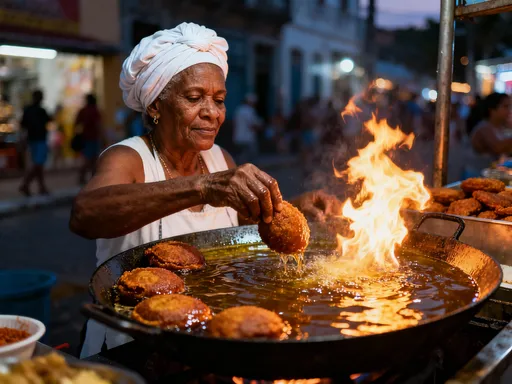
No dish embodies the spirit of Salvador quite like acarajé. At first glance, it might resemble a deep-fried patty split open and stuffed with savory fillings. But to reduce it to a street snack is to miss its deeper meaning. Acarajé is a ritual, a symbol, and a living artifact of African resistance and resilience. Traditionally prepared by iyabás dressed in white robes and headwraps, it is sold at street corners, ferry terminals, and sacred plazas like Terreiro de Jesus, where the scent of hot dendê oil fills the air like incense.
The process begins before dawn. Black-eyed peas are soaked, peeled by hand, and ground into a smooth paste. The batter is shaped into rounds and dropped into vats of sizzling dendê oil, where they puff and crisp into golden-brown orbs. This act of frying is not casual—it is sacred. In Candomblé tradition, acarajé is offered to Exu, the orisha of crossroads and communication, believed to open paths and carry messages between worlds. When sold on the street, each piece carries that spiritual weight, even as it feeds the bodies of passersby.
The proper way to eat acarajé is deliberate. It is split open and filled with vatapá (a creamy paste of bread, shrimp, coconut, and palm oil), caruru (a okra-based stew with nuts and shrimp), and a fiery sauce made from malagueta peppers. Each ingredient has significance: the shrimp representing the ocean’s bounty, the okra a direct link to African cooking, the heat a reminder of life’s intensity. Eating it is an act of participation—not just in Bahian cuisine, but in a centuries-old tradition of faith and resistance.
Supporting an iyabá by purchasing acarajé is also an act of solidarity. These women are more than vendors; they are cultural keepers. Many face economic hardship and social marginalization, yet they continue their work with dignity, preserving a culinary practice that could easily be lost to time. By choosing to buy from them—by waiting patiently, by accepting the food with gratitude, by refraining from intrusive photography—travelers can honor this tradition rather than exploit it. In this exchange, food becomes a bridge between worlds, a moment of mutual respect.
The Sea’s Bounty: From Praia do Porto to Moqueca
Salvador’s identity is inseparable from the ocean. Nestled along the Atlantic coast, the city has long relied on fishing as both an economic lifeline and a cultural practice. At Praia do Porto and other working waterfronts, fishermen return each morning with nets heavy with snapper, grouper, shrimp, and octopus. These catches make their way quickly to local markets and kitchens, ensuring that seafood in Salvador is never frozen, rarely farmed, and always fresh.
No dish showcases this maritime heritage better than moqueca baiana, a rich fish stew that simmers for hours in clay pots. Unlike its counterpart from São Paulo, which uses tomatoes and olive oil, Bahian moqueca relies on coconut milk and dendê oil for its signature creaminess and color. Layers of fish, onions, peppers, tomatoes, and cilantro are slow-cooked to allow flavors to meld, then finished with a squeeze of lime and a splash of fresh coconut water. The result is a dish that tastes of the sea, the tropics, and time itself.
The choice of fish matters. Locals prefer firm varieties like robalo (snook) or garoupa (grouper), which hold their shape during cooking. The clay pot, known as a panela de barro, is equally important—it distributes heat evenly and imparts a subtle earthiness to the stew. Some families guard their moqueca recipes fiercely, passing them down like heirlooms. Others adapt them, adding local shrimp or substituting ingredients based on the day’s catch.
For visitors, the best moqueca is often found not in upscale restaurants but in unassuming beachfront shacks known as barracas. Places like Barraca do Oswaldo or Marisqueira Forró serve heaping portions on banana leaves, with sides of farofa (toasted cassava flour) and pirão (a thick manioc porridge made from the stew’s broth). Dining here means eating with the sound of waves in your ears and sand beneath your feet. It’s a reminder that in Salvador, the line between nature and nourishment is beautifully thin.
Markets as Theaters: Mercado Modelo and Beyond
If Salvador’s streets are its heartbeat, its markets are its soul. They are not merely places to shop but vibrant stages where culture, commerce, and community intersect. Mercado Modelo, perched on a cliff overlooking the bay, is the most famous. Once a customs house, it now houses dozens of stalls selling handmade crafts, jewelry, and, most importantly, food. The air is thick with the scent of dried shrimp, smoked fish, and tropical spices. Glass jars display colorful powders—urucum for coloring, clove for flavor, ginger for warmth—each with its own story.
But Mercado Modelo, while beautiful, is only the beginning. For a deeper understanding of daily food life, one must visit Feira de São Joaquim, a sprawling market where locals do their weekly shopping. Here, the rhythm is faster, the language more direct, the prices more honest. Vendors call out the day’s specials: “Fresh crab! Just landed!” “Mangoes, sweet and ripe!” “Dendê oil, pure, no water added!” Baskets overflow with yams, malanga root, green bananas, and bundles of cilantro. Women in aprons haggle over prices, children dart between stalls, and elders sit on stools, sipping coconut water through straws.
These markets are also centers of culinary education. Watch how a vendor prepares a quick snack—grilling queijo coalho (a rubbery cheese that doesn’t melt) over open flame, then drizzling it with honey. Observe the care with which dried shrimp are sorted by size, or how coconut meat is freshly grated on hand-cranked mills. Nothing is hidden. The process is part of the product. For the traveler, this transparency is a gift—a chance to see food not as a commodity but as a craft.
And then there is the cachaça. Not the mass-produced kind, but artisanal varieties distilled in small batches, infused with passion fruit, ginger, or even acai. Sold in reused bottles with handwritten labels, these spirits reflect the ingenuity of Bahian producers. Buying a bottle isn’t just a souvenir—it’s a connection to a tradition of fermentation, distillation, and celebration that stretches back generations.
Sweet Endings: Cocadas, Quindim, and the Art of Bahian Desserts
While savory dishes dominate Salvador’s reputation, its desserts offer a quieter, equally powerful expression of cultural fusion. Sweetness here is not an afterthought but a celebration of patience, craftsmanship, and memory. Street corners are dotted with women selling cocadas—hand-rolled coconut candies in shades of white, brown, and gold. Some are soft and chewy, others hard and crackly, each batch reflecting the maker’s touch. The recipe is simple—coconut, sugar, water—but the results vary widely, shaped by heat, timing, and instinct.
Then there is quindim, a custard-like dessert baked in small porcelain cups. Made from egg yolks, sugar, and grated coconut, it emerges from the oven with a glossy, amber surface that cracks slightly at the edges. The texture is dense yet silky, the flavor rich without being cloying. It traces its roots to Portuguese conventual sweets, where nuns used egg yolks (left over from using whites to starch clothes) to create elaborate desserts. In Bahia, it was transformed by the addition of coconut, making it uniquely local.
Other treats tell similar stories of adaptation. Doce de leite, a milk-based caramel, is often spiced with cinnamon, a nod to both European and African flavor preferences. Manjar branco, a coconut flan, is served with a syrup of red guava, creating a striking contrast of white and crimson. These desserts are rarely found in fancy patisseries. Instead, they appear at family gatherings, religious festivals, and neighborhood kiosks—places where sweetness is shared, not sold.
For the traveler, trying these desserts is a way to slow down, to savor a different pace of life. Sitting on a bench in a shaded plaza, licking coconut from your fingers, you begin to understand that in Salvador, food is not just about hunger. It is about care, about memory, about the small moments that make a day feel complete.
Eating Like a Local: Practical Tips for the Curious Traveler
Experiencing Salvador’s food scene authentically requires more than a full stomach—it demands curiosity, respect, and a willingness to step off the beaten path. The best meals often come without menus, without chairs, and without rush. To truly connect with the city through its cuisine, consider these practical tips.
First, time your meals with local rhythms. Lunch, known as almoço, is the main event, typically served between 12:00 and 2:00 PM. This is when family restaurants and comidinhas (small eateries) offer full spreads of rice, beans, salad, and daily specials. Arriving early ensures freshness; arriving late risks missing out. Dinner is lighter and later, often consisting of snacks like acarajé or grilled cheese.
Second, approach street food with care. While generally safe, it’s wise to choose vendors with high turnover and visible hygiene practices. Look for those using gloves or tongs, frying food to order, and keeping ingredients covered. Bottled or canned drinks are safer than ice-based beverages unless you’re certain the ice is made from purified water.
Third, practice respectful photography. Many iyabás and market vendors are proud of their work but may not welcome being photographed without permission. A simple smile and a gesture of asking—hands clasped, nodding toward your camera—can go a long way. If they decline, honor that. The moment is not yours to take; it’s one to witness.
Finally, be open to combination plates. Salvador’s cuisine is about harmony—of flavors, textures, histories. Don’t shy away from trying moqueca with farofa, or acarajé with a side of fresh fruit. Ask locals for recommendations. A simple “O que você recomenda?” (What do you recommend?) can lead to the best meal of your trip.
Ultimately, eating in Salvador is not just about taste—it’s about connection. Every dish carries a story, every vendor a legacy. When you sit down to eat, you’re not just a tourist. You’re a guest in a long, ongoing conversation about survival, joy, and the enduring power of food to bring people together. To taste Salvador is to understand it—not with your mind, but with your heart.